
The Math&Move e-books are designed to introduce mathematical concepts to young learners through engaging stories that provide a concrete context. By linking abstract math concepts to real-world scenarios, these e-books make learning math both enjoyable and effective.
Here are three key ways these resources help young learners understand abstract math concepts:
Contextual learning through storytelling
Storytelling is a powerful tool used in the Math&Move e-books to provide context to mathematical concepts. Research indicates that using narratives and contextual examples helps students understand and retain mathematical concepts better by making them relatable and memorable.
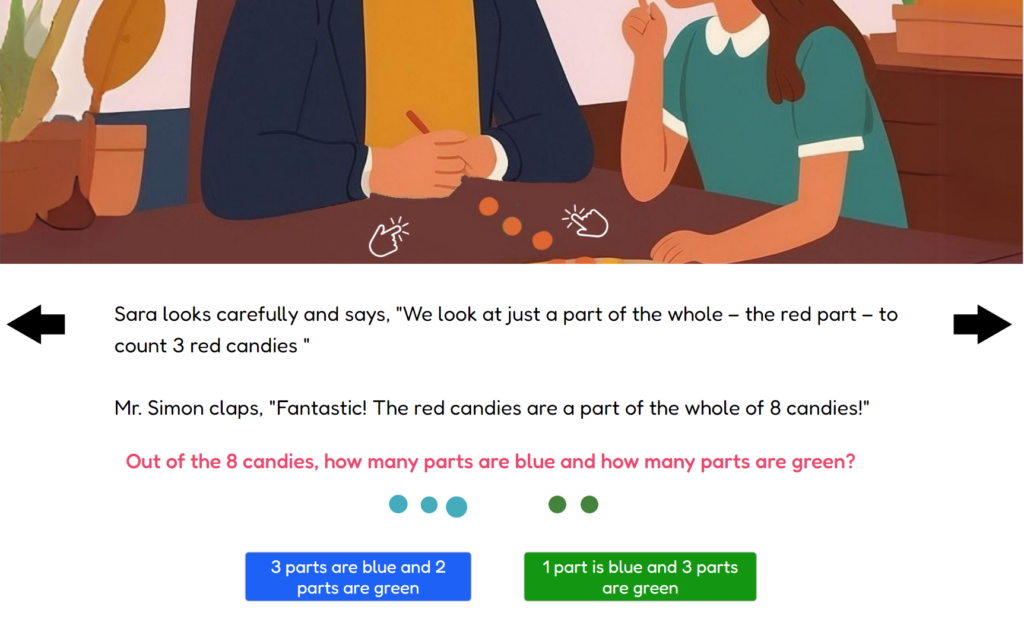
Each of our ebooks immerses pupils in a narrative where they take on different roles, such as acting as architects to build a futuristic city. Contexts such as these help children see the practical applications of geometry in real life. By constructing buildings using polygons and polyhedra, pupils can begin to grasp the relevance of math in everyday activities and future professions. In other stories, characters use and apply familiar objects and activities to portray a relatable context, such as using candies to learn fractions. This narrative makes the abstract concept of fractions more tangible by linking it to something familiar and enjoyable for children—candy. By breaking down the candies into parts and wholes, readers can visually and physically see the fractions, simplifying a topic which at first may have seemed daunting.
Interactive elements for multisensory learning
Another feature given priority in the creation of the Math&Move e-books is the use of interactive elements, which cater to multisensory learning. Multisensory learning involves engaging multiple senses simultaneously, and is known to improve comprehension and retention of new information, making its use in educational e-books particularly effective.
Each e-book contains clickable elements that reveal different parts of the story and mathematical concepts gradually. For example, in “I Can Build a City of the Future!”, readers click on images to reveal hidden polyhedra, helping them understand the three-dimensional aspects of shapes. This interactive approach ensures that children engage with the material in multiple ways—visually, audibly, and kinesthetically—enhancing their overall learning experience.
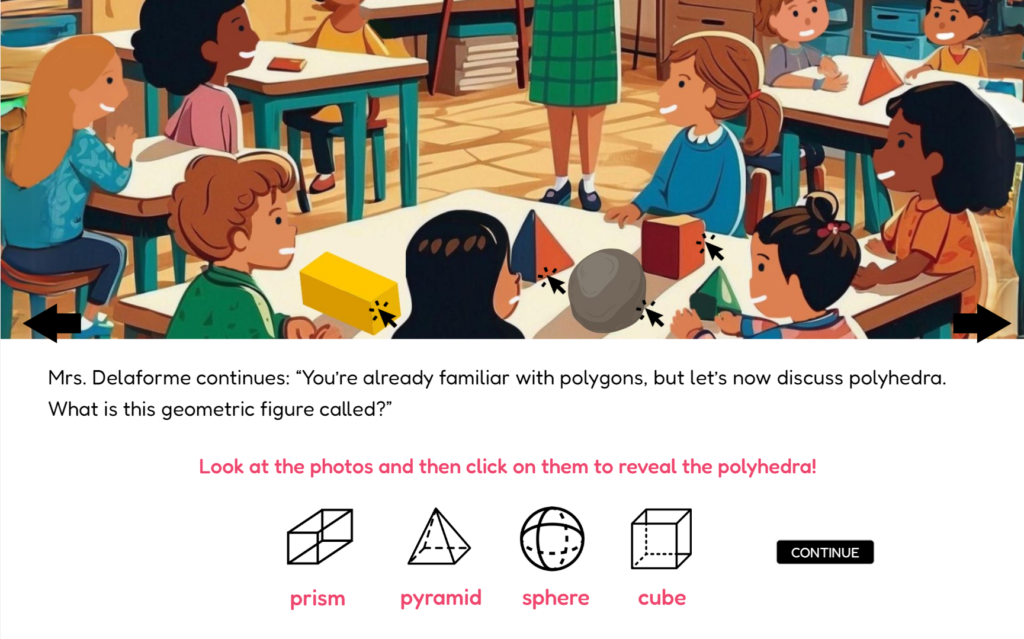
All ebooks also contain musical elements, to help learners better identify important story plots or just create an engaging and pleasant atmosphere for learning. By enabling children to interact with the story through actions and clicks, our goal was to help learners (especially those struggling with “math-phobia”) develop a deeper understanding and enjoyment of the different mathematical concepts.
Collaborative learning and problem-solving
The stories contained in our e-books also promote collaborative learning and problem-solving, essential skills for young learners. Collaborative learning has been shown to enhance learner engagement and understanding by allowing them to learn from and with their peers, making the educational experience more dynamic and interactive.
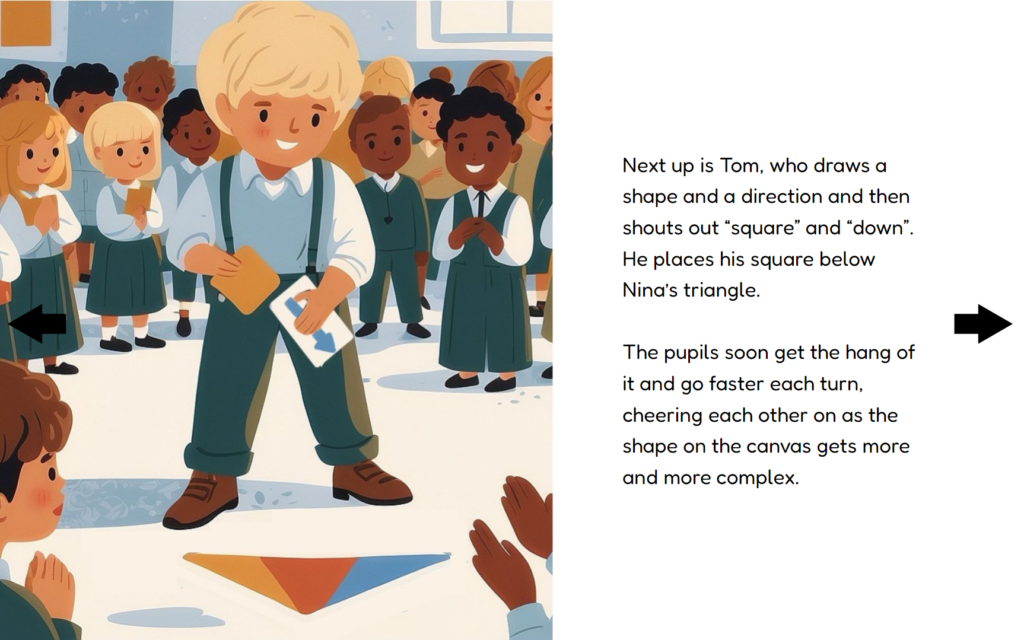
For example, in “I Can Build Complex Shapes!”, characters work together to place shapes on a canvas following specific directions. This activity not only teaches readers about sides and edges but also encourages teamwork and communication as the story takes them through the building of a complex shape collectively. Similarly, in other ebooks the characters discuss and solve problems together, such as figuring out how to make a stable structure using different shapes or how to add up the sums on a hopscotch board. Group activities such as these mirror real-life scenarios where collaborative problem-solving is an essential step for relating to peers and improving soft skills, thereby preparing readers for similar challenges they may come across, in and out of the classroom
By combining storytelling, interactive elements, and collaborative learning, our e-books make abstract math concepts accessible and enjoyable. This holistic approach not only enhances children’s understanding of math but also fosters a love for learning through engaging and dynamic methods. For more information on the Math&Move project and to explore these innovative e-books, check them out here.